Introduction
Wondering how much a towel radiator costs to run? See real UK running costs for electric, central heating and dual fuel towel radiators, plus easy ways to cut your bill.
How much does a towel radiator cost to run? It depends less on the radiator itself than on the job you are asking it to do. A rail used only to dry two towels for an hour a day costs very little. The same rail used to heat an entire bathroom for most of the day costs considerably more. Before any number on this page means anything, it helps to separate these two uses, because towel radiator running costs come down to hours of use, wattage and heat output, not one fixed number that applies to every household.
This guide walks through how to work out your own towel radiator energy consumption, compares electric, central heating and dual fuel towel radiators side by side, and covers the sizing, controls, materials and small habits that make a real difference to your bathroom heating costs.
Towel Warmer or Room Heater? The Question to Answer First
Every towel radiator falls into one of two roles, and knowing which one yours plays changes the entire running-cost picture.
A towel warmer dries and warms towels and takes the chill off a small room. Wattages between 150W and 300W, used for an hour or two around shower time, are typically enough, and the daily operating cost stays low.
A whole-room heater is expected to bring an entire bathroom up to a comfortable temperature, not just warm a towel. This needs a higher heat output, often 400W to 900W or more, and it may run for several hours a day rather than one or two. A bigger job costs more to run, whatever the tariff.
Work out which job your radiator is doing before you look at wattage or price — it is the single most useful step in understanding your own bathroom heating costs.
The Only Running Cost Calculation You Actually Need
Electricity is billed in kilowatt hours (kWh), and a radiator's electricity cost is simply its wattage, converted to kilowatts, multiplied by the hours used and your tariff's price per unit. Calculations use Ofgem’s average electricity unit rate of 26.11p per kWh for Direct Debit customers on standard variable tariffs in Great Britain from 1 July to 30 September 2026. Check your own bill for the tariff applicable to your household.
|
Wattage |
Cost per hour |
Cost for 2 hours a day |
Cost per month (2 hrs/day) |
Annual running cost (2 hrs/day) |
|
150W (towel drying only) |
3.9p |
7.8p |
around £2.35 |
around £28.59 |
|
300W (towel plus light room warmth) |
7.8p |
15.6p |
around £4.70 |
around £57.18 |
|
600W (part room heating) |
15.7p |
31.3p |
around £9.40 |
around £114.36 |
|
900W (full room heating) |
23.5p |
47p |
around £14.10 |
around £171.54 |
Two things change this in practice. A programmable timer avoids paying for hours when nobody is in the bathroom, and an off-peak tariff such as Economy 7 can shift some of the cost to cheaper overnight rates if the rail is timed to warm towels before a morning shower.
Same Radiator, Different Bill: How Usage Patterns Change the Cost
Manufacturers tend to quote one average figure, but actual bathroom heating costs vary by how the rail is used, not by who happens to own it.
One shower, one towel: the lightest use case. Running a 150W to 200W rail for an hour before and after a single daily shower keeps annual costs modest, since the rail is only ever asked to dry one towel and take the edge off the room briefly.
Several showers in a short period. When showers happen back to back, the rail often stays on for one long stretch to keep pace with towels arriving one after another, pushing both the hours used and the total cost well above the single-shower pattern.
All-day warmth, not just drying. In a poorly insulated bathroom, or wherever the rail is asked to hold genuine room warmth for several hours rather than dry a towel quickly, wattage and hours both climb, and cost rises with them.
Irregular schedules. Where use varies from day-to-day and the rail isn't reliably switched off by hand, a thermostatic model with a sensible output cap keeps the bill predictable regardless of how the rail is used on any given day.
Summer-only electric use. Where central heating already covers the colder months, the rail draws its own power only through the warmer half of the year, so the true annual cost is a fraction of a rail run on electric mode all year.
Electric, Central Heating, or Dual Fuel: Which One Actually Saves You Money?
An electric towel radiator runs entirely on mains electricity, independent of the boiler, and its running cost is governed purely by wattage, hours and your electricity tariff, as calculated above. It suits flats without central heating, or any bathroom where you want the rail available all year without switching between fuel sources.
A central-heating towel radiator may have a relatively low incremental running cost while the boiler is already heating the home, although it still contributes to the system's overall heat demand. It also cannot operate once the central heating is switched off.
A dual fuel towel radiator combines both, drawing boiler heat in winter and running its own electric element in summer. It costs a little more to buy and fit than either option alone, but it removes the choice between winter economy and summer availability, and for a household that already has central heating and simply wants warm towels year-round, it is often the most sensible middle ground.
|
Central heating only |
Electric only |
Dual fuel |
|
|
Running cost pattern |
Relatively low incremental cost while the boiler is already on |
Wattage × hours × tariff, year-round |
Lower incremental cost in winter, standard electric cost in summer |
|
Year-round availability |
No |
Yes |
Yes |
|
Best suited to |
Homes that rarely use the bathroom outside the heating season |
Flats without central heating, or those wanting added flexibility |
Homes wanting both winter economy and warmth outside the heating season |
Across the year. The same rail can cost very differently depending on season and setup. Summer towel drying on an electric element is a light, warm-weather-only load. Winter whole-room heating is the heaviest, running longer at a higher wattage. Year-round electric use sits between the two, carrying the load in every month. On a dual fuel rail, the boiler carries winter warmth while the electric element handles summer towel drying — and with central heating alone, the rail adds to boiler demand in winter but isn't available once the heating is off.
Once you have decided which fuel type suits your home, you can browse electric towel radiators for year-round flexibility, dual fuel models for both winter economy and summer warmth, or central heating towel radiators if your boiler already does the work.
Thermostats, Timers: The Hidden Cost Lever
The most basic, uncontrolled elements can run at full wattage until switched off by hand, which is usually the most expensive way to operate a rail. That isn't true of every non-adjustable model, though: non-adjustable doesn't always mean no thermostat, and some fixed-temperature rails still cycle against a factory-set point rather than running flat out.
A thermostatic towel radiator reaches a set temperature, then cycles on and off to hold it — its duty cycle drawing meaningfully less power over an hour than its rated wattage suggests. A programmable towel radiator adds scheduling on top, warming the rail before you wake and switching off once the household has left for the day. Smart towel radiators extend this with app control and learning schedules, useful for households with irregular routines.
Wattage and controls also work together. A higher-wattage thermostatic model may reach the target temperature sooner and then cycle off, while a lower-wattage model may run for longer to hold the same warmth, so a higher rating does not automatically mean a higher bill. Whichever control type you choose, the running-cost table above assumes the rail is on for the stated hours only, so good controls are what keep real bills close to those figures rather than drifting toward constant operation.
Two Radiators, One Wattage, Two Very Different Running Costs
It is a common source of confusion: two towel radiators both rated at 300W, yet one runs up a higher bill, or never feels as warm as the other. Wattage only tells you the most power a rail can draw — and since two electric rails of the same wattage turn nearly all of it into the same amount of heat, the real differences lie in how that heat is spread, how much reaches the room, and how long the rail runs.
Design changes how the heat is delivered rather than how much is produced. It affects heat distribution across the rail, surface temperature, how quickly the rail warms up, how much of a towel touches warm metal, how freely air circulates around it, and therefore drying speed and how warm the room feels. A single panel concentrates heat on one face, so that surface runs hotter, while a double panel or multi-bar design spreads it across more metal, cooler to the touch, but giving a towel more warm surface to dry against.
The room matters too: a bathroom with poorly insulated external walls loses heat to the outside faster overall, so more of the rail's output goes toward offsetting that loss and less is left to raise the temperature. And the duty cycle plays its part: a well-controlled, well-insulated thermostatic model cycles off sooner than a basic rail of the same wattage left running continuously.
Two 300W rails are comparable on paper, but that is no guarantee they will cost, or feel, the same in your bathroom.
Does Covering the Rail With Towels Change Anything?
A towel radiator does two jobs at once: it dries towels and it releases heat into the room. Draping towels over every bar shifts the balance toward drying, because the towels absorb heat that would otherwise warm the air, so less reaches the room until they dry. This matters mainly when the rail is doubling as a room heater – for towel drying alone it is exactly what you want. If you are relying on the rail for warmth, leaving some bars clear lets more heat reach the room while towels dry on the rest.
Steel vs. Stainless Steel: Which Build Actually Saves You Money?
Wattage and hours of use decide most of your running cost. The build of the rail decides how that heat is delivered and how long the radiator keeps working without extra spend — not how much electricity it uses.
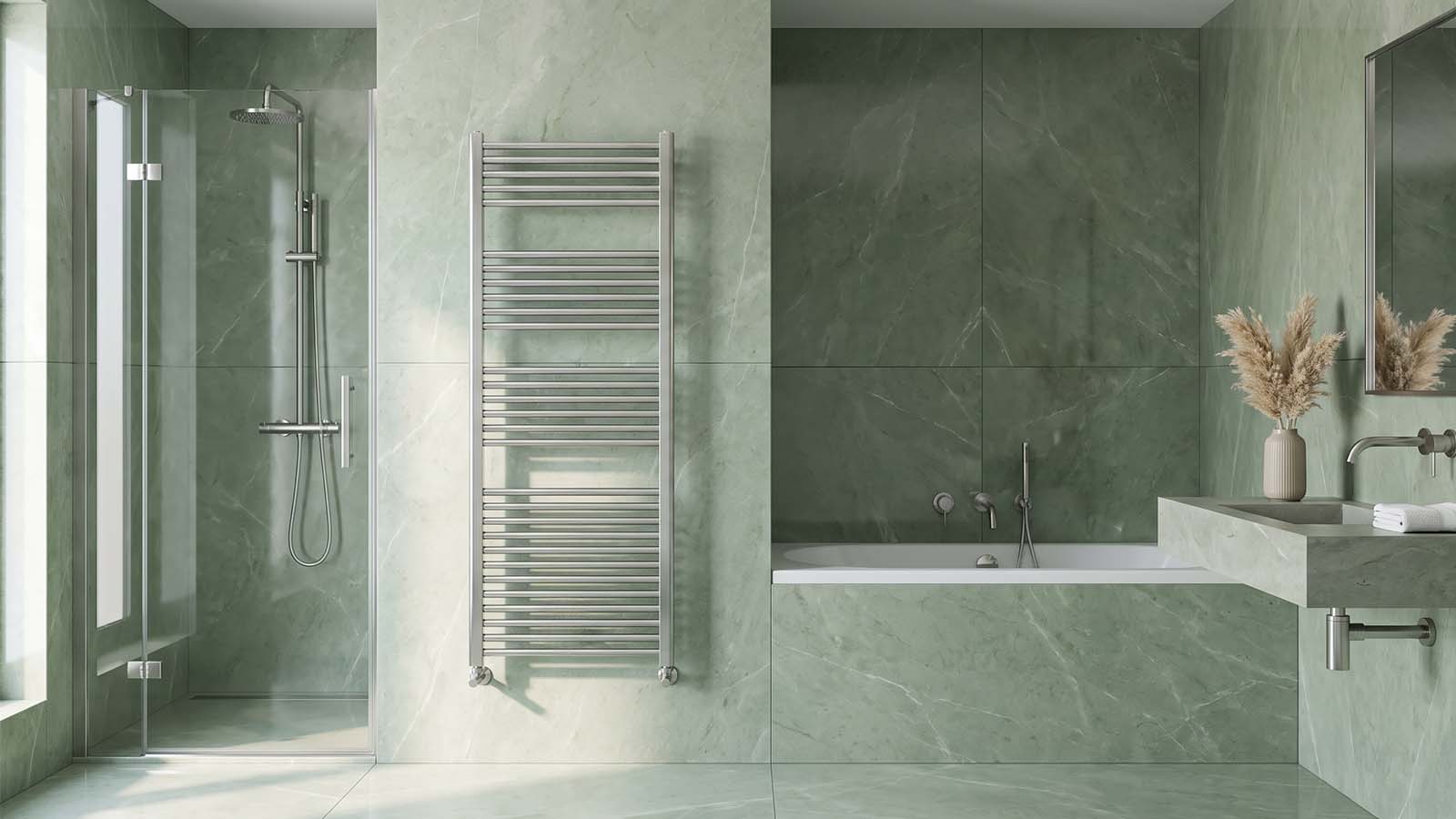
Steel vs. stainless steel: Most budget and mid-range towel radiators are made from mild or carbon steel with a powder-coated or chrome-plated finish. This keeps the price down and conducts heat well, but the finish is what protects the metal underneath from moisture, so a chip or scratch in a humid bathroom can eventually lead to surface corrosion. Stainless steel costs more upfront and resists corrosion throughout the metal itself rather than relying on a surface finish, which suits bathrooms with poor ventilation, daily shower use or coastal humidity. Whether it offers better long-term value depends on the bathroom conditions, the quality of the radiator and how long it is kept. It does not reduce electricity consumption: at the same wattage and operating time, two rails use the same power.
Panel types and bar counts: A single panel radiator is the simplest and usually the cheapest, offering one flat heated surface. A ladder or multi-bar radiator spreads the same wattage across several bars, giving more room for towels to hang separately and dry faster, which can mean shorter running times for the same result. A double panel design sits between the two, adding a second heated surface for extra surface area without the full bar count of a ladder style. None of these change the wattage on the spec sheet, but they do change how much of that wattage you need to run, and for how long, to get dry towels and a warm bathroom.
Finish and coating: Chrome, anthracite, white and black finishes are mostly a styling choice, but the coating quality behind the colour affects longevity as much as the steel grade beneath it. A cheap chrome finish can dull, pit or flake within a few years in a humid bathroom, while a well-applied powder coat on either steel or stainless steel tends to outlast it. When two radiators look identical in a listing photo, finish quality is one of the least visible but most consequential differences between them.
The bottom line on materials: Material and construction can affect heat distribution, warm-up characteristics, corrosion resistance and product lifespan, but the rated electrical input remains the same. At the same rated wattage and operating time, two electric towel radiators consume the same electricity. Differences in material and build quality influence durability, maintenance and long-term ownership costs far more than day-to-day energy use.
Watts, BTUs and Heat Loss: What Each Number Actually Means
These figures are easy to confuse, partly because three of them can be quoted in the same unit. Keeping them apart is what stops you comparing the wrong numbers.
Electric element wattage is electricity drawn. A 300W electric rail pulls 300W from the mains, and because resistive heating is effectively 100% efficient, it delivers 300W of heat. The wattage is both its consumption and its output — one fixed figure that doesn't change with how you run it.
Hydronic radiator output is heat delivered, not electricity drawn. A water-fed rail takes its heat from the boiler or heat pump and uses no electricity of its own, so its watt figure is an output rating, quoted at a stated delta T (ΔT) — the gap between the water and the room. The same rail puts out less when the water runs cooler, so a hydronic 600W is only 600W at the ΔT it was tested at (often ΔT50 in the UK, lower on heat-pump systems). It is not comparable to 600W of electrical consumption.
BTU per hour is simply another unit for what an output watt measures: the rate of heat delivered. UK radiator specs often quote it. Since 1 watt ≈ 3.4 BTU/hr, a 2,000 BTU/hr rail is about 586W of output — and whether that figure is trustworthy still depends on the ΔT behind it.
Bathroom heat-loss requirement is a property of the room, not of any heater. It is how much heat the space loses on a cold day — set by size, insulation, glazing, ventilation and target temperature (bathrooms are usually specified warmer) — and therefore how much output you need to hold that temperature. You size the heater to meet it. In anything larger than a small ensuite, a towel rail often isn't meant to cover the whole figure alone; it frequently supplements underfloor heating or a second radiator, with the heat-loss calculation sizing the system as a whole.
Bars, Width, and Spacing: Getting the Size Right for Your Household
Running cost is only half the story: a rail that cannot dry your towels properly may need to run longer to achieve the same result. As a general guide, a rail with around 5 to 7 bars and a width of 400–500 mm may suit one or two towels, while a wider ladder radiator with around 8 to 12 bars and a width of 500–600 mm may take three or four. These are examples rather than fixed rules. How many towels a radiator holds depends not only on bar count but also on rail width, bar spacing, grouped-bar arrangement, towel size, whether towels are folded or spread out, and whether the design offers open-sided access. Spacing matters for drying too: closely spaced bars can cause towels to overlap, while wider spacing allows better airflow. Sizing for BTU or wattage should follow the same logic as the towel warmer versus whole-room heater distinction: choose the output based on whether your priority is drying towels or heating the room.
Running costs are only part of the financial picture. A fair comparison also weighs the purchase price, installation, expected maintenance and the conditions the radiator will work in. Models with thermostats or programmable controls typically cost more upfront; better controls may offset part of that higher purchase price by reducing unnecessary operating time, depending on usage. Stainless steel models also cost more upfront, and their greater corrosion resistance may be worthwhile in bathrooms with consistently high humidity or poor ventilation. The most cost-effective option depends on installation costs, usage patterns, electricity tariffs, bathroom conditions and how long the radiator is expected to remain in service.
Finding the Right Towel Radiator for Your Household
For towel drying only, a compact electric towel radiator with a thermostat — in whichever finish suits the bathroom — keeps running costs low. For a household needing both drying and genuine room warmth, a higher-wattage electric or dual fuel radiator, sized properly, is worth the extra upfront cost. For anyone with existing central heating who wants the rail available all summer, a dual fuel towel radiator is the most balanced option, provided the existing rail can accept an added element. For a high-humidity bathroom, or a rail you plan to keep for a decade or more, stainless steel is worth considering.
The lowest-wattage rail is not automatically the cheapest or best value: it still has to do the job. A rail too small to dry your towels or warm the room may simply run longer, or fall short. Match the output to the task first, then let controls and material decide value over the years you own it.
|
Your main requirement |
Most suitable option |
|
Towel drying only |
Low-wattage electric rail (150–300W) with a thermostat and timer |
|
Whole-room heating |
Higher-output electric or dual fuel rail, sized to the room's heat loss |
|
Summer use alongside central heating |
Dual fuel, using the electric element out of season |
|
Existing central heating, winter only |
Central-heating rail plumbed into the system |
|
Irregular routines |
Thermostatic or smart rail that holds a set temperature predictably |
|
Large or poorly insulated bathroom |
Towel rail for drying plus a separate panel radiator or underfloor heating |
|
Several towels used daily |
Wider ladder rail with more bars and generous spacing |
Once you know which of these fits your bathroom, you can compare heated towel rails and designer towel radiators by wattage and material to find the right one.
Six Small Changes That Cut Your Running Costs
Cutting your bill rarely means buying a different radiator. It usually means a handful of small habits.
- Size it correctly first. The biggest saving comes from not buying more wattage than the job needs. Revisit the towel warmer versus whole-room heater question before anything else.
- Fit a thermostat and timer. A rail that switches itself off once towels are dry, rather than running until someone remembers, is consistently cheaper to own over a year.
- Use an off-peak tariff where you can. If your supplier offers Economy 7 or a similar rate, timing the rail to warm towels overnight or just before a morning shower shifts cost onto cheaper units.
- Insulate the bathroom. An insulated, draught-proofed room holds warmth between cycles, so an identical rail runs its duty cycle less often to maintain the same comfort.
- Follow the manufacturer's maintenance instructions. Check periodically for leaks, damaged controls, loose fixings or signs of corrosion. Electric elements are generally sealed — don't remove or attempt to descale one unless the manufacturer specifically tells you to.
- Arrange towels for airflow. Avoid overlapping them, leave gaps between them, spread them across the available bars, and remove them once dry. A rail with suitable width and spacing finishes the job faster than a crowded one.
None of these involve replacing the radiator, and together they are usually worth more than choosing between two similarly specified models on price alone.